

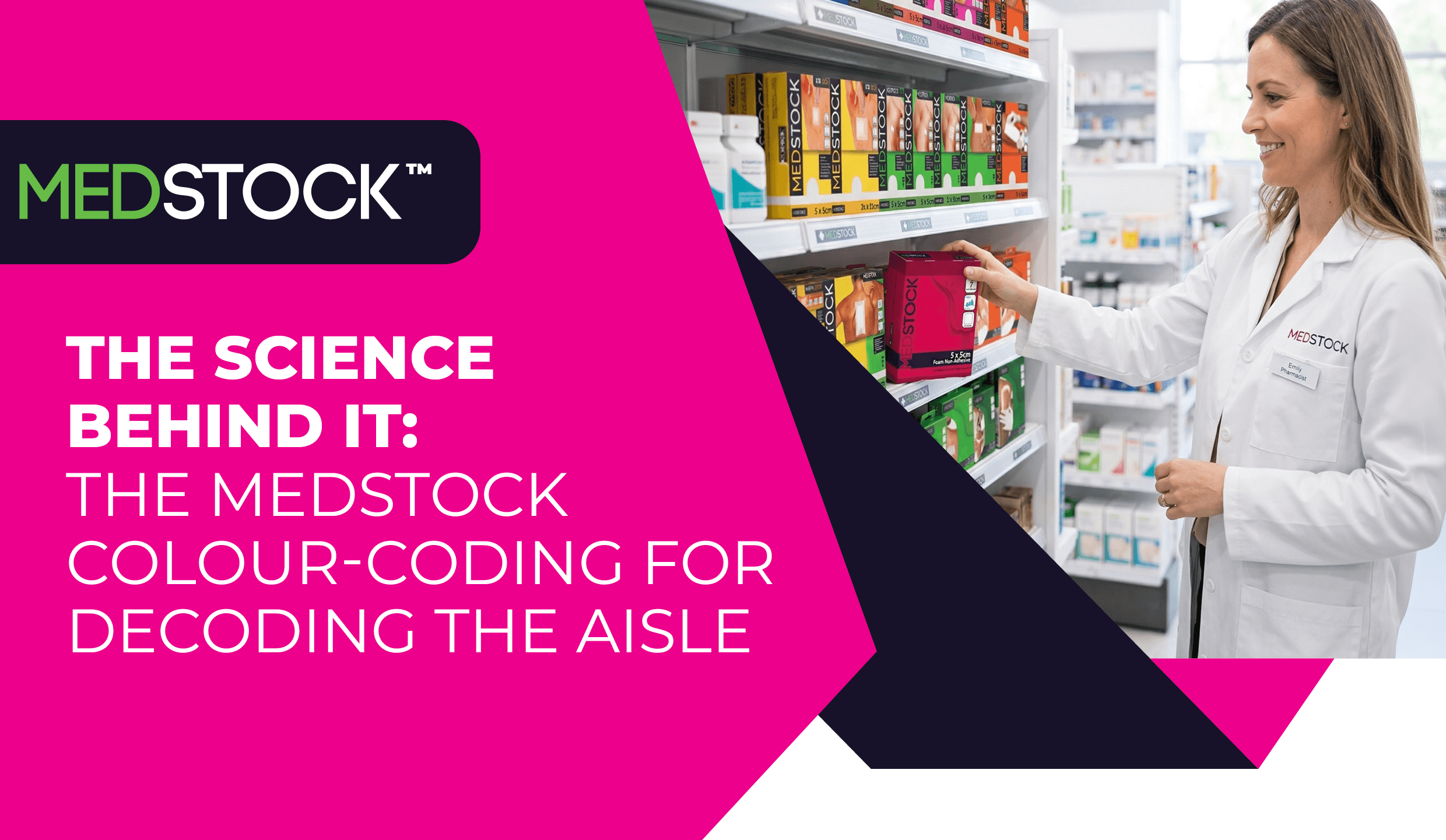
The science behind why the right colour on the shelf promotes the right dressing on the wound.
Picture this. A customer walks up to the pharmacy counter. Holding up their bandaged hand, slightly flustered, they say: “I cut my palm while slicing an apple. What do I need?”
In that moment, the pharmacy assistant has to assess the situation and navigate a wound care aisle that could easily hold a dozen different dressing types, each with clinical terminology on the box. That’s a recipe for hesitation, rummaging, and second-guessing, resulting in a doubtful customer who isn’t sure they’ve been given the best advice.
This is exactly the scenario Medstock designed its colour-coding system to solve. And the science behind it runs deeper than aesthetics.
Colours aren’t random – they map to wound biology
When every box looks the same, every selection takes longer than it should.
Medstock’s colour-coded packaging isn’t a marketing exercise. Each colour corresponds to a dressing category defined by its physical properties and moisture-handling capability – the two most clinically meaningful variables in dressing selection.
Consider the spectrum:
- Yellow signals fabric island dressings, first-line protection for low-exudate wounds like grazes and abrasions.
- Pink denotes the silicone range, gentle adhesion specifically for fragile or aged skin, where standard adhesives risk stripping the epidermis.
- Red indicates foam non-adhesive dressings, high-absorption products suited to the ongoing fluid management demands of ulcerated wounds.
- Grey marks the super-absorber range for wounds with very high fluid output, where conventional dressings would be quickly overwhelmed.
- Army green identifies alginates, derived from seaweed, capable of promoting clotting for wounds with active bleeding alongside high exudate.
The progression from yellow through to grey roughly tracks wound complexity and fluid burden. That’s not a coincidence, it’s a deliberate design logic that encodes clinical knowledge into a visual system.
Colour coding provides a practical starting point. Dressing choice should also consider fluid level, wound condition, surrounding skin, and individual patient needs.
Medstock started the trend
Medstock was among the first wound care suppliers to introduce colour-differentiated packaging across a complete range, drawing directly on our clinical experience.
What began as a clinical insight has since been validated by research in adjacent healthcare settings. Studies in hospital pharmacy have shown that colour-coded product zones for rapidly dispensed medications improve both efficiency and medication safety by making retrieval faster and more intuitive. The same cognitive principle applies on the pharmacy floor – when the visual system does the first layer of sorting, the brain can focus on the finer clinical judgement.
Simple nomenclature. Faster consult.
One of Medstock’s most underappreciated design decisions is its product naming.
Rather than adopting complex clinical terminology, Medstock uses plain descriptors. We don’t ask pharmacy teams to decode a phrase like “non-adherent polyurethane foam dressing with CMC hydrophilic granules.” We call it what it is: Foam Non-Adhesive.
In the same way, a “thin-profile bordered silicone adhesive foam dressing” becomes Silicone Foam Lite, a “high-capacity exudate-retentive dressing” becomes Super Absorber, and a “non-invasive adhesive skin closure device” becomes Wound Closure.
This matters enormously at the point of sale. A pharmacy assistant doesn’t need to know the full biochemistry of hydrocolloid gel formation to recommend the right dressing – they need to know that the blue box is for dry wounds and minor burns, and that it maintains moisture balance.
The name confirms it.
The colour signals it.
The consultation becomes a conversation, not a clinical exam.
The modular advantage: building the right solution
Many wound presentations require a combination of products. A non-stick pad (orange) needs a fixer roll to stay in place. A burn patient may need a hydrogel beneath a hydrocolloid. An alginate dressing needs a secondary fixation layer.
Because Medstock’s colour system categorises products by function rather than format alone, it naturally supports modular thinking. Staff learn to recognise not just which colour applies to the wound, but which colours work together – turning a potential upsell moment into a genuinely better clinical outcome for the patient.
Solving choice paralysis and reducing error
Research in behavioural science shows that more options can lead to decision paralysis and a higher rate of selection errors.
Medstock’s colour system functions as an error-reduction architecture. Narrowing the field of consideration before clinical specifics are even assessed reduces the cognitive load on staff and the probability of a mismatch. This shared visual language shortens the learning curve for new staff, locums, and pharmacy assistants.
Quick identification. Right dressing
The Medstock Advantage Colour-Coding System ultimately delivers one thing: confidence at the shelf.
When a pharmacy assistant sees the pink box, they know it’s for fragile skin. When a customer points to a weeping surgical wound, the green options come into view immediately. The colour does the first clinical sort. The pharmacist applies the final judgement.
That’s not oversimplification – it’s smart design that respects both the complexity of wound care and the reality of a busy pharmacy environment.
To explore the full Medstock wound care range, visit medstock.com.au.
Disclaimer
All information is general and not intended as a substitute for professional advice.
References
- Jairoun, A. A., Al-Hemyari, S. S., Shahwan, M., El-Dahiyat, F., & Al-Ghananeem, A. M. (2025). Improving efficiency in hospital pharmacy systems: the case for color-coded zones for rapidly dispensed medications. Journal of Pharmaceutical Policy and Practice, 18(1). https://doi.org/10.1080/20523211.2025.2493169,
- Iyengar, Sheena & Lepper, Mark. (2001). When Choice is Demotivating: Can One Desire Too Much of a Good Thing?. Journal of Personality and Social Psychology. 79. 995-1006. 10.1037/0022-3514.79.6.995, https://www.researchgate.net/publication/12189991_When_Choice_is_Demotivating_Can_One_Desire_Too_Much_of_a_Good_Thing,
Countless wound care decisions are made each day in community pharmacies. Wounds Australia reports that more than 450,000 Australians experience chronic wounds each year and each patient faces out-of-pocket costs of about $4,000 each to manage them.
Management of acute wounds sits within the scope of practice of every pharmacist, with some now developing more extensive skills. Busy pharmacy staff are moving between prescriptions, stock control and customer conversations. Even small delays in identifying the right product can lead to longer queues at the counter.
Medstock’s colour-coded packaging was developed to reduce that friction – indeed, we were one of the first to introduce this concept, drawing on our own clinical experience with time management when undertaking wound care tasks .
Designed for real-world workflow
Medstock uses colour families to simplify the process of dressing selection for pharmacy customers and staff:
- Yellow: Fabric island dressings for minor wounds such as grazes and abrasions
- Orange: Non-stick pads requiring secondary fixation
- Pink: Silicone range for fragile skin and skin tears
- Green and dark green: Transparent island and film dressings for those recovering from surgery
- Blue: Thin hydrocolloid for dry wounds and minor burns
- Red: Foam non-adhesive for ulcerated wounds
- Army green: Alginate for higher absorption and bleeding control
- Grey: Super absorber for heavily weeping wounds.
This grouping enables you to assess the wound and narrow down product selection more quickly.
Wound care remains complex, and dressing selection depends on several factors. Colour-coding is intended as a practical starting point, but some wounds may fall into more than one colour category.
For example:
- Minor burns may require a hydrocolloid dressing (blue) or a non-stick pad (orange).
- Ulcers may require foam non-adhesive (red) or alginate (army green), depending on fluid output.
Supporting real-world pharmacy practice
Community pharmacy is a high-interruption environment where pharmacists balance dispensing, counselling, management and patient enquiries in parallel.
Even experienced staff may feel rushed when advising a customer. When every dressing box looks similar, they must pause to read the fine print, resulting in microdelays or mistakes.
Colour-coded packaging supports:
- Instant visual differentiation on shelves
- Clear distinction between fluid levels and dressing types
- Faster stock retrieval.
For distributors and pharmacy partners, this translates to:
- Fewer selection errors
- Smoother onboarding of new staff
- Reduced product confusion during busy periods.
Faster decision-making in practice
Consistent colour coding enables staff to narrow options more efficiently before confirming final clinical suitability.
When dispensing medications, research in hospital pharmacy found that colour-coded zones for rapidly dispensed medications can improve efficiency and medication safety by making retrieval faster and more intuitive.
While wound care selection is distinct from drug administration, the same principles apply. When products are clearly differentiated by colour, staff spend less time scanning labels and more time responding to customers.
In busy pharmacies, even small reductions in hesitation, rechecking and visual search can contribute to smoother workflows and more confident product selection.
Reduced staff hesitation and greater confidence
New staff, locums and pharmacy assistants may feel hesitant when navigating wound care ranges. A clearly structured colour system supports faster orientation.
Instead of memorising numerous product codes, staff learn high-level colour categories for certain wounds or skin types. That shared visual language reduces hesitation at the shelf and increases consistency in recommendations, particularly in pharmacy environments where wound care discussions may occur at the counter.
Operational benefit, not clinical oversimplification
It is important to reinforce that wound care is dynamic. Dressing choice must consider wound condition, surrounding skin and many other factors. As a wound heals, the most appropriate dressing may also change
Colour coding does not remove that complexity – and there may be times when the best advice a pharmacist can give is that the patient seeks medical or nursing care.
Supporting education and product adoption
For pharmacy partners, colour coding supports:
- Improved stock visibility and shelf presentation
- Clearer catalogue and website presentation
- Quicker product identification and narrowing
- Reduced cognitive load for staff
- More effective product demonstrations and internal training
- Easier cross-selling within wound categories
- Stronger brand consistency across the range.
When staff understand the logic of the range, adoption increases. When adoption increases, repeat ordering follows.
Medstock further supports this with QR codes on product pouches linking to application guidance and safe use information
Partner with a system built for busy pharmacy teams
Medstock’s colour-coded packaging is part of a broader commitment to practical clinical solutions designed for real-world healthcare settings.
To explore the full wound care range:
For distributor enquiries or training resources, please contact us.
Disclaimer
This information is intended for healthcare professionals.
References
- Wounds Australia, Pre-Budget Submission to fight Australia’s chronic wound epidemic, January 2022, https://treasury.gov.au/sites/default/files/2022-03/258735_wounds_australia.pdf,
- Jairoun, A. A., Al-Hemyari, S. S., Shahwan, M., El-Dahiyat, F., & Al-Ghananeem, A. M. (2025). Improving efficiency in hospital pharmacy systems: the case for color-coded zones for rapidly dispensed medications. Journal of Pharmaceutical Policy and Practice, 18(1). https://doi.org/10.1080/20523211.2025.2493169,
Stock selection in pharmacy is a strategic decision that influences clinical credibility, category performance, professional positioning and long-term brand alignment.
Pharmacy owners and head office teams should evaluate a wound care supplier through a commercial and professional lens rather than being unduly influenced by promotional pricing.
Strategic context: the evolving role of pharmacy
Community pharmacy is the most accessible form of primary healthcare with more locations and longer opening hours than other providers. No wonder then, that it continues to expand its role in Australian primary healthcare with an increasing scope of practice that includes prescribing and vaccinating as well as compounding and dispensing.
In wound care alone, patients seek advice from their pharmacist for minor wounds, post-procedural care, chronic wound support and dressing selection.
Wounds Australia reports that 450,000 Australians suffer from chronic wounds. On average, each patient pays approximately $4,000 out-of-pocket each year for wound care. Those with venous leg ulcers or diabetic foot ulcers face even higher costs.
In this context, wound care forms an important part of the professional healthcare offering within pharmacy. Wounds UK highlights the importance of pharmacy teams understanding wound management principles and appropriate dressing selection to support safe care and referral where required.
The opportunity beyond first aid
Some pharmacy suppliers focus exclusively on first aid. These brands often have no footprint in medical or hospital markets and are positioned primarily as retail consumer products.
Medstock differs in several material ways:
- Clinicians founded and direct the business
- Product architecture reflects clinical categories, not just retail segmentation
- The portfolio spans both basic and advanced wound care, catering to a wider range of pharmacy clients
- Products are supplied across medical, aged care and hospital environments, providing clinical continuity
Our clinically relevant portfolio supports professional positioning and enables pharmacy teams to offer solutions beyond adhesive strips and basic bandaging.
A clinically grounded wound care partner
A supplier that aligns with professional healthcare standards, supports workflow efficiency, and enables category expansion contributes to both clinical service delivery and commercial resilience in pharmacy.
Medstock delivers:
- Clinical relevance: A wound care portfolio that extends into advanced dressings, silicone technologies, alginates and hydrocolloids. This supports the considerable number of patients who require more than minor first aid.
- Credibility through cross-sector presence: Medstock is not only active across pharmacy, medical and hospital channels. We also hold a NSW Health contract for wound care, casting and compression products, and our products are included on the Commonwealth Government’s Chronic Wound Consumables Scheme. Together, these markers strengthen Medstock’s credibility as a supplier operating beyond retail and within formal government procurement and care pathways.
- Structured product architecture: Clear product naming and colour identification systems support operational efficiency and ease of recognition for pharmacy teams.
Commercial considerations
From a commercial standpoint, decision-makers typically assess:
- Category margin potential
- Differentiation versus competitors
- Long-term supplier stability
- Range breadth
- Brand credibility at point of sale
Products that do not offer clear differentiation are often treated as interchangeable, leading to increased price sensitivity and margin pressure.
A clinically grounded brand allows pharmacies to:
- Position wound care as a professional service
- Support higher value dressing categories
- Reduce direct comparison with purely price-driven first aid brands
- Enhance professional trust with customers
Our structured, clinically coherent portfolio also reduces risk by:
- Simplifying product identification to enable more accurate advice
- Supporting staff confidence
- Aligning with established wound care frameworks
Corporate social responsibility and brand alignment
Modern pharmacy procurement increasingly considers supplier values alongside commercial metrics.
Medstock’s continued partnership with Save Our Supplies demonstrates our ongoing commitment to reducing medical waste and supporting global health initiatives.
This collaboration means:
- Suitable medical supplies that can no longer be sold are redirected to healthcare services overseas
- Extended life and impact of these products
- Practical support for communities with limited access to essential medical resources
Aligning with responsible suppliers supports corporate governance frameworks and community positioning.
A strategic supplier decision for long-term category strength
Wound care is not a transactional retail category. It sits at the intersection of clinical service, professional trust and commercial performance.
Choosing Medstock supports pharmacies to:
- strengthen the clinical integrity of the category
- differentiate from price-driven competitors
- support more informed patient conversations
Cross-sector credibility reinforces trust at the counter. Structured product architecture improves operational clarity for teams. Responsible supply initiatives reflect the standards increasingly expected of modern healthcare organisations.
Medstock’s position beyond retail pharmacy is further supported by its NSW Health contract and the inclusion of Medstock products on the Commonwealth Government’s Chronic Wound Consumables Scheme product list.
The wound care category can remain a commoditised retail aisle, or it can evolve into a more professionally led healthcare offering. Supplier choice plays a meaningful role in shaping that direction.
Please contact the Medstock team for further discussion.
Disclaimer
This information is intended for healthcare professionals.
References:
- Pharmacy Guild of Australia, Guild plan puts community pharmacy at the forefront of primary healthcare, https://www.guild.org.au/news-events/news/2025/guild-plan-puts-community-pharmacy-at-the-forefront-of-primary-healthcare,
- Wounds Australia. (2024). Wounds Australia annual report 2023–24. https://woundsaustralia.org/int/woundsaus/uploads/Governance/agm%202024/wa%20annual%20report%202023_24_final_small.pdf
- Wounds UK, Wound care and dressing selection for pharmacy teams, https://wounds-uk.com/wp-content/uploads/2023/02/03b0723c7390236ecd2ef3d990ef4a55.pdf
- NSW Government. (2024, September 17). Wound care, casting and compression products – HSSP_HC22_264. buy.nsw. https://buy.nsw.gov.au/notices/EEBAD82B-F2F1-D3CD-A2447D7D31C7F39F
- Australian Government Department of Health, Disability and Ageing. (2025, June 20). Chronic Wounds Consumable Scheme product list. https://www.health.gov.au/resources/publications/chronic-wounds-consumable-scheme-product-list